

THE CULTURE EDIT
Heritage, Reworked
How Indian craft, culture and design are being reinterpreted for a new generation of fashion..
FEATURED ARTICLE
Heritage, Reworked
Fashion has always borrowed from somewhere.
We often think of Paris, London and Milan as the fashion capitals of the world — places where trends are born, designers set the tone and new ideas eventually make their way into our wardrobes.
The runways become the reference point.
The fashion houses become the names we remember.
The cities become synonymous with what is considered contemporary.
READ MORE
But Look a Little Closer
Where do some of those ideas come from?
Fashion has never really existed in isolation.
A silhouette travels. A technique gets reinterpreted. A textile moves from one culture into another and eventually appears somewhere completely unexpected.
And sometimes, what looks like a new fashion idea has a much older history behind it.
India has been part of that history for centuries.
Indian textiles such as chintz and calico were highly sought after in Europe from the 17th century onwards. In France under Louis XIV, their popularity became so significant that the government eventually restricted their import and sale. The fascination continued despite those restrictions, with Indian textiles influencing European dress, interiors and design.
So when we talk about Indian influence on fashion today, it isn’t really a new conversation.
It is an old relationship being looked at differently.
The Craft Behind the Fashion
For a long time, much of the connection between India and international luxury existed quietly.
The finished garment might carry the name of a European fashion house, while the embroidery, embellishment or handwork behind it could have involved Indian artisans.
One Vogue India report on Indian artisans and Paris couture described Indian embroidery as deeply embedded in the couture ecosystem, while also highlighting how the contribution of Indian ateliers was historically kept relatively invisible.
That distinction matters.
Because there is a difference between being part of fashion and being seen as part of fashion.
India has never lacked craftsmanship.
What has been changing is the visibility of the people, techniques and traditions behind it.
When Paris Looked to India
One of the clearest examples came from Dior’s Spring/Summer 2022 Haute Couture presentation in Paris.
For the show, Dior worked with Indian artists Madhvi and Manu Parekh and Mumbai’s Chanakya School of Craft. Large embroidered artworks created by Indian artisans became part of the runway environment, covering approximately 340 square metres of the show’s backdrop.
The collaboration brought together two very different fashion languages.
Parisian haute couture.
Indian craftsmanship.
But it wasn’t simply about placing an Indian motif onto a European garment.
The embroidery itself became part of the artistic language of the show.
And that is where the relationship becomes more interesting.
The craft wasn’t simply decoration. It became the medium.
From Inspiration to Interpretation
This is where contemporary Indian fashion starts to become particularly interesting.
Because heritage doesn’t have to remain exactly as it was inherited.
A traditional textile can be cut into an unfamiliar silhouette.
Embroidery can become structure rather than surface decoration.
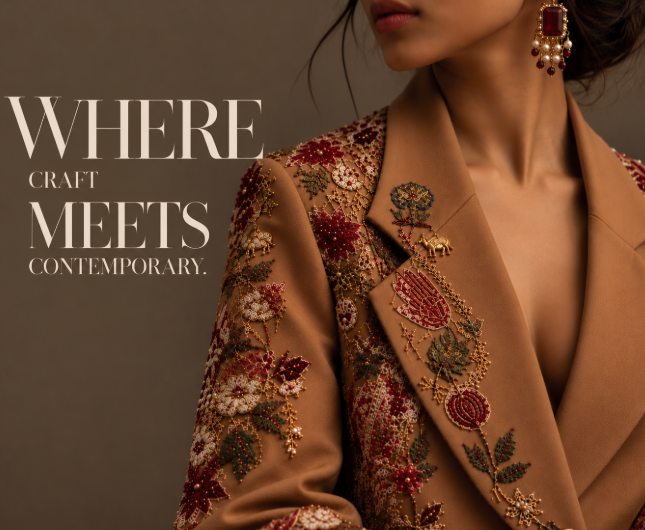
A centuries-old technique can appear on a garment that feels completely contemporary.
The craft remains recognisable.
But the context changes.
At Vogue India’s Forces of Fashion showcase in 2025, designer Rahul Mishra described reimagining bandhani not simply as a textile, but as structure — taking the memory, culture and tradition of the craft and translating it into architectural silhouettes.
That is the difference between preserving heritage and designing with heritage.
One looks backwards.
The other asks what comes next.
India Is Becoming Part of the Main Conversation
And increasingly, Indian designers aren’t only being discussed in relation to traditional craft.
They’re becoming part of the wider global fashion conversation.
Indian couture appeared repeatedly on international red carpets and stages throughout 2025, with designers including Anamika Khanna, Gaurav Gupta, Rahul Mishra and Manish Malhotra dressing international celebrities and appearing in increasingly global fashion contexts.
The Met Gala has become one particularly visible stage for this shift.
In 2025, Anamika Khanna made her Met Gala debut with a look that combined Indian heritage with the event’s tailoring theme and incorporated global craft references. Rahul Mishra’s earlier work at the Gala had similarly brought Indian embroidery techniques such as zardozi, nakshi and dabka into an international fashion setting.
And in 2026, the conversation moved even further.
Manish Malhotra’s Met Gala cape incorporated zardozi, chikankari, kasab and dori work, while the names and signatures of the artisans involved were embroidered into the piece itself. The garment reportedly took more than 960 hours and involved 50 artisans across Mumbai and Delhi.
That detail feels especially significant.
Because the people behind the craft were no longer invisible.
Their names became part of the garment.
The Maker Becomes Part of the Story
For years, luxury fashion often worked through mystery.
The finished product was what mattered.
The designer’s name appeared on the label. The house became the story. The craftsmanship was understood as part of the value, but the individual hands behind it could remain anonymous.
That model is becoming harder to sustain.
Consumers are increasingly interested in where something comes from, who made it and what goes into making it.
And fashion is responding.
When a designer puts the artisan’s name into the garment itself, the craft becomes more than a production process.
It becomes part of the identity of the piece.
This is particularly relevant for India, where craft traditions are deeply connected to communities, regions and generations of knowledge.
The value isn’t only in the final garment.
It is also in the knowledge required to make it.
Heritage Doesn’t Have to Look Traditional
Perhaps this is the biggest change.
For a long time, Indian heritage fashion was easily associated with certain visual codes:
Rich colour.
Heavy embroidery.
Traditional silhouettes.
Bridalwear.
Ornament.
But Indian designers are increasingly playing with those expectations.
A textile doesn’t have to look traditional simply because it is traditional.
A technique doesn’t have to produce a familiar silhouette.
And an Indian fashion identity doesn’t have to choose between being rooted and being contemporary.
The most interesting work can do both.
It can carry the memory of a place without looking like a costume from its past.
From Borrowed Influence to Original Language
This also changes the way we should think about India’s relationship with global fashion.
The story isn’t simply that international fashion houses have discovered Indian craftsmanship.
That would make India a supporting character in somebody else’s fashion story.
The more interesting story is that Indian designers are increasingly taking the same ingredients — textiles, embroidery, craft, colour, architecture, history and cultural memory — and creating their own contemporary language from them.
That language doesn’t need to imitate Paris.
It doesn’t need to reject Paris either.
It can exist alongside it.
And perhaps that is the real shift.
India isn’t trying to become another fashion capital.
It is becoming more confident about what it already has.
So, What Does “Reworked” Really Mean?
Heritage isn’t static.
It changes every time someone new interprets it.
A textile changes when a designer cuts it differently.
An embroidery technique changes when it appears on a new silhouette.
A traditional motif changes when it enters a completely different cultural conversation.
And a craft changes when the person making it is finally given visibility.
That is why the future of Indian fashion doesn’t have to be about choosing between tradition and modernity.
It can be both.
A handwoven textile with an unexpected cut.
A centuries-old embroidery technique on a contemporary silhouette.
A sari styled in a way nobody would have imagined twenty years ago.
A global runway where Indian artisans aren’t hidden behind the finished garment, but acknowledged as part of its creation.
Studio Origin Take
Fashion has always moved through exchange.
Ideas travel. Techniques evolve. Designers borrow, reinterpret and respond to the cultures around them.
But the most interesting shift happens when a culture doesn’t simply become an influence on fashion — it becomes the author of its own contemporary language.
India has never lacked craft.
What is changing is the way that craft is being positioned, designed and seen.
The next chapter may not be about making Indian fashion look more global.
It may be about making the world look at Indian fashion on its own terms.
And perhaps that is what it means to rework heritage.
Not to leave the past behind.
But to give it somewhere new to go.
.
IDEAS WORTH A SECOND LOOK
THE CULTURE EDIT · FASHION & CULTURE
The New Status Symbol Is Knowing Less
Why quiet luxury, understated design and low-logo fashion became so compelling — and why personal style may matter more than following the code.
When Quiet Became the Look
For a long time, luxury was supposed to be recognisable. The logo mattered, the monogram mattered, and the statement bag or obvious designer piece that everyone could identify from across the room became part of the language of status.
Then the mood changed.
Quiet luxury made restraint desirable. Suddenly, the most expensive-looking outfit was often the one that didn’t appear to be trying too hard. Neutral colours, clean silhouettes, minimal branding, good fabrics and understated accessories became the visual language of a new kind of sophistication.
The idea was simple: if you knew, you knew.
The Appeal of Being Understood
Quiet luxury wasn’t simply about wearing less. It was about creating a different kind of status — one that didn’t need to announce itself to everyone in the room.
A logo tells people what you’re wearing. A barely recognisable designer piece assumes they already understand. That distinction made quiet luxury particularly appealing in a culture where everything had become increasingly visible online.
For a while, not showing off became its own form of showing status.
Then the Internet Found It
There is something slightly ironic about quiet luxury becoming an internet trend. The aesthetic that was supposed to feel effortless suddenly had a vocabulary of its own: “old money”, “stealth wealth” and “quiet luxury” became searchable ideas.
Social media turned what was once an instinct or personal style into something people could search for, save, recreate and shop. Suddenly, there were endless guides explaining how to look expensive without looking like you were trying to look expensive.
And that created a strange contradiction. The more people tried to understand quiet luxury, the more recognisable its rules became.
The Code Became the Trend
Once an aesthetic becomes easy to identify, it becomes easy to reproduce.
Beige trousers, a white shirt, loafers, structured bags, minimal jewellery and soft tailoring are not new ideas. What changed was the way they were being packaged together as a recognisable visual language.
Eventually, that language became another trend.
That doesn’t mean quiet luxury disappeared. It simply means that its biggest influence may have been something broader than the aesthetic itself. It made people reconsider what they wanted fashion to communicate.
From Looking Expensive to Looking Like Yourself
The interesting shift happening now is that people seem less interested in following one perfect definition of sophistication.
Fashion is becoming more personal again. Someone can wear a structured blazer with colourful jewellery. Someone else can combine a vintage skirt with a designer bag and sneakers. Another person might genuinely prefer an all-neutral wardrobe.
There doesn’t have to be one correct answer.
The outfit doesn’t necessarily need to belong to one aesthetic anymore. It can belong to the person wearing it.
The New Maximalism Is More Personal
This is also why the return of maximalism doesn’t necessarily mean quiet luxury has failed. Fashion rarely moves in clean opposites. Minimalism can exist alongside maximalism, and understatement can exist alongside drama.
Someone can want a quiet, beautifully cut coat one day and an oversized pair of earrings the next. The difference is that the choice increasingly feels personal rather than dictated by a single trend cycle.
Perhaps that is what comes after the aesthetic era of social media: people becoming more comfortable taking pieces from different worlds and making them their own.
The End of the Perfect Code
The internet made aesthetics incredibly easy to discover. You could search for an aesthetic, find hundreds of references and build an entire wardrobe around it within an afternoon.
But the same thing that makes aesthetics easy to discover also makes them easier to exhaust.
Once everyone knows the formula, the formula stops feeling particularly interesting.
This doesn’t mean trends are disappearing. It means people may be becoming more selective about which parts of them they actually want to keep.
What This Means for Fashion
For brands, this creates an interesting challenge.
Selling an aesthetic is easy when consumers want to buy into a clearly defined world. But increasingly, consumers may want pieces that can move between worlds: a handbag that works with tailoring and denim, jewellery that feels elegant with a simple dress but equally interesting with something more dramatic, or a jacket that can be styled traditionally or completely differently.
The value is no longer necessarily in belonging to one aesthetic.
It is in versatility and personal interpretation.
Studio Origin Take
Maybe the new status symbol isn’t actually knowing less. Maybe it is needing less recognition.
Quiet luxury made understatement aspirational. But the next phase may be less interested in giving everyone the same definition of sophistication.
Some people will still want the logo. Some will want the barely recognisable designer piece. Some will want colour, jewellery and drama. Others will mix all three.
Because fashion has always been a language. And perhaps the most interesting change isn’t whether we speak loudly or quietly.
It’s whether we still need everyone to understand what we’re saying.